
Comparing online and home tutoring for a specific learner
A practical checklist for deciding between online and home tutoring based on observable traits of a specific learner, covering screens, attention, materials, travel and feedback needs.
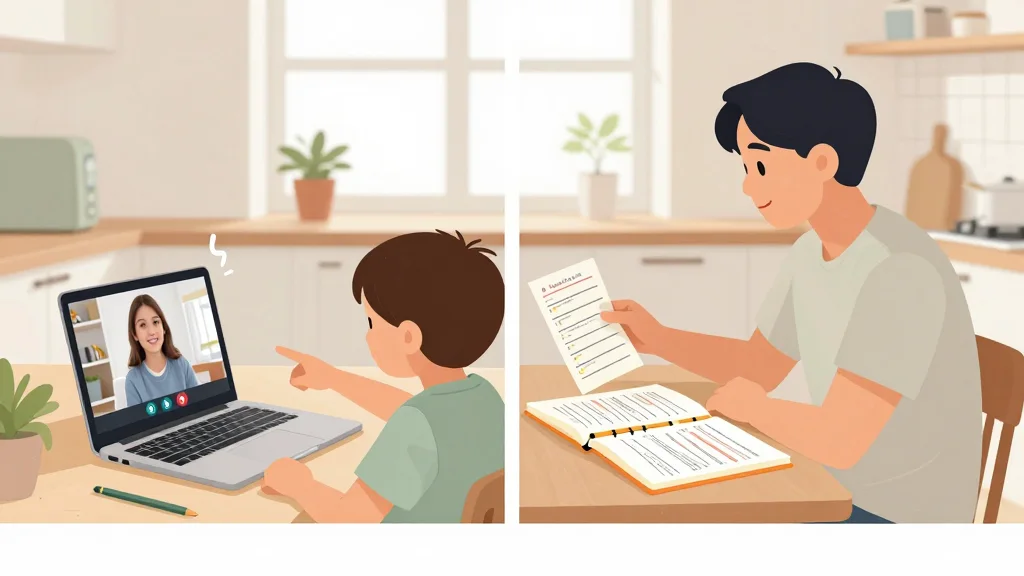
The decision you are actually making
You are not choosing between two philosophies of teaching. You are choosing between two arrangements for one particular learner: will they concentrate better in their own room or at a kitchen table, and can the tutor's method work through a screen or does it need a whiteboard and a pencil handed across?
The honest answer is conditional. Some learners thrive on the structure of a home visit; others do better with the low-pressure option of staying put. The checklist below helps you sort out which is which without guessing.
Comfort with screens
Watch how your learner uses a tablet or laptop for ordinary tasks. Do they settle into a video call for twenty minutes without fidgeting, or do they drift after five? For a child, notice whether they ask to watch a screen or ask to put it away.
You can run a short trial: ask the learner to video-call a friend or relative and hold the conversation for ten minutes while you observe. A learner who manages that comfortably is likely to cope with a screen-based session. One who struggles may still manage with a tutor who keeps interaction brisk and uses the camera actively, but it is a factor to weigh.
Attention span and session length
Home tutoring often suits learners who need a longer, uninterrupted block, because the tutor is physically present and the household can be quieted around the visit. Online sessions are frequently shorter, which can be an advantage for a learner whose attention fades after thirty minutes.
Consider what a realistic session looks like for this person. If they work best in twenty-five-minute bursts, an online tutor who structures sessions that way may serve them better than a home tutor who expects an hour at a table.
Need for hands-on materials
Some subjects lean on physical objects: manipulatives for early maths, a real book for handwriting practice, a lab bench for science. If the learner's current work involves handling things, a home visit removes the friction of shipping materials or improvising substitutes.
For example, a child learning to write letters benefits from a tutor who can see the pencil grip and correct it directly. An online tutor can still do this with a camera angle and a printed worksheet, but the correction loop is slower. If hands-on work is central to the goal, note that as a point in favour of home tutoring.
Travel and logistics
A home tutor means travel time for the tutor and possibly for the learner, plus coordination around who is home. An online session needs only a device, a stable connection and a reasonably quiet corner.
If the learner lives far from a suitable tutor, or if the household schedule makes a fixed weekly visit difficult, the online option removes a recurring logistical burden. Conversely, if travel is already part of the routine, a home visit may not add much cost.
Feedback and supervision
A home tutor can watch for the small signals of confusion: a furrowed brow, a pencil hovering, a learner who stops writing without asking a question. Online, the tutor relies on the learner to say something is unclear, or on the learner's visible hesitation on camera.
For a child who is reluctant to admit they do not understand, the physical presence of a tutor can make it easier to ask. For an adult learner who is self-directed, the ability to pause, replay a screen recording or send a photo of their work between sessions may be equally useful.
A simple comparison to fill in
Write down the learner's name and the subject. Then answer five questions: Does this learner settle well on a screen? How long can they focus before needing a break? Does the work require physical materials? How much travel is involved? Does the learner need a tutor to notice confusion on their behalf?
You do not need a perfect score for either format. A learner who scores three for online and two for home is not disqualified from either; it tells you where to negotiate. You might accept an online arrangement if the tutor agrees to longer sessions and sends practice materials in advance, or accept a home visit if the tutor is willing to travel to a library rather than the home.
A concrete next step
Before booking anything, ask two or three tutors to describe how they would run a first session for this particular learner and subject. Listen to whether they ask questions about the learner's habits, not just their exam dates. A tutor who wants to know whether your child can sit still for forty minutes, or whether your adult learner prefers working from photographs of their own notes, is giving you useful information about how the format will actually work.